In this article
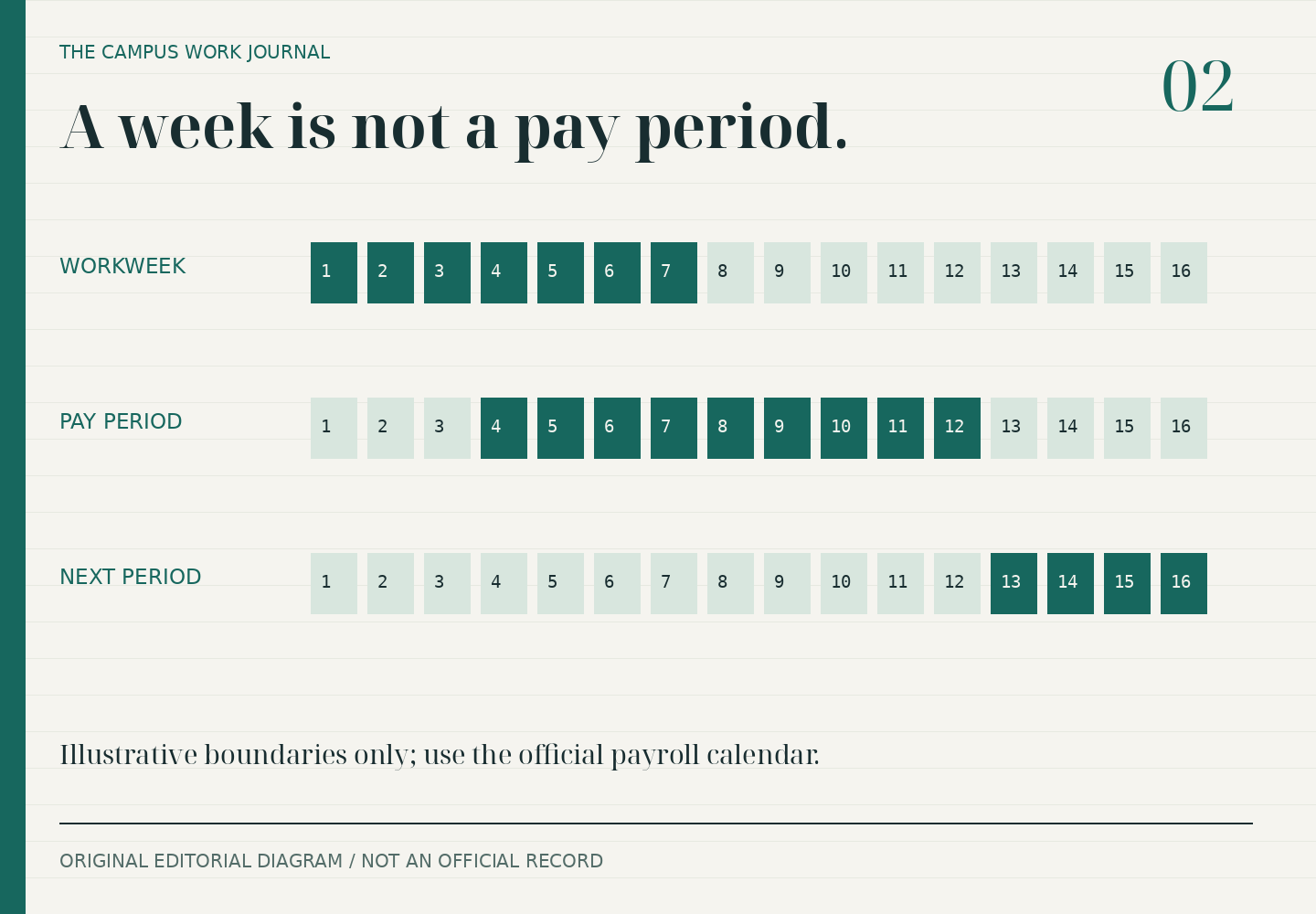
A pay period is a container. A workweek is another container. They do not always share boundaries, which means a statement can present a set of weekly earnings inside a payroll period without making the whole period one uninterrupted calculation. Understanding that distinction is especially useful when an overtime line looks different from the hourly rate you expected.
The University of Utah's Paycheck FAQ: October 2023 Payroll Changes explains a paycheck-display change introduced in October 2023. It describes a rate column that displays the FLSA regular rate rather than the multiplied overtime rate, and it discusses weeks that cross pay-period boundaries. The page remains available as official context at our October 15, 2026 review. Its explanation is a reason to read the display carefully, not a promise that every employee's current screen looks identical.
Begin with the earnings amount and its labels
A common shortcut is to look at a rate, recognize a familiar number, and assume the adjacent amount must equal that number multiplied by the hours. Sometimes that is the relationship. Sometimes the display uses the rate for a different purpose. Before checking multiplication, read the earnings code, week, units, and column headings as one group.
Consider a fictional row with five hours, a displayed reference rate of twenty dollars, and earnings of one hundred fifty dollars. Dividing the supplied earnings by the supplied hours gives thirty dollars per hour. That is a description of those fictional numbers. It does not establish which rate should legally apply, whether the hours are correct, or whether the employee is entitled to the payment.
The distinction is subtle but important. A row can be arithmetically interpretable without being independently verified. The public FAQ helps explain why a display might not show the number a reader expected. The employee's actual circumstances still need the University's explanation if there is uncertainty.
Build the week before comparing the period
Put the rows into the weeks they identify. A period-wide total can conceal a missing row, a duplicated row, or a shift between weekly categories. Reading week by week gives each question a smaller boundary. It also makes it easier to distinguish a display concern from a concern about the underlying time record.
In a fictional exercise, week A contains ordinary earnings and an additional line; week B contains ordinary earnings alone; week C is only partly represented in the period being examined. Do not merge the three into an average and ask why that average differs from a familiar hourly rate. The average throws away the structure you need to understand the individual rows.
Instead, ask which dates each row covers and whether the third week's treatment is complete in the current record. If the University explains that an item belongs to another period, preserve the reference to that later period. Then check the actual later record. An explanation of expected timing is useful, but it is not the same as observing the finished result.
A calendar boundary is not an error by itself
The Paycheck FAQ: October 2023 Payroll Changes states that the University's FLSA week runs Saturday through Friday and explains that overtime associated with a week crossing a pay period may appear in the following pay period. That is a narrow statement about the published explanation. It should not be stretched into a rule that any missing payment will automatically arrive later.
When a concern involves a boundary, identify both the workweek and the pay period. “The last week is missing” may mean several things: the display omits detail, a particular code is absent, or a calculation has not been explained. A more useful inquiry identifies the dates and asks how the relevant week is represented across the statements.
Avoid treating the end of a month as the governing boundary simply because it is visually memorable. Payroll calendars, workweeks, and personal budgeting periods serve different purposes. The University's current Payroll Schedule and Deadlines is the place to establish the official period labels, rather than deriving them from a bank notification or a calendar app.
Keep additional earnings attached to their explanation
A displayed rate can change for reasons that are not visible in one row. The official FAQ notes that the regular rate can reflect additional earnings. This article does not attempt to reproduce that legal calculation. The practical reading lesson is to preserve the surrounding earnings categories and ask which components the University included.
A fictional employee who compares only two rate cells may conclude that a base wage changed. That conclusion is premature if the cells represent a calculated regular rate for two different weeks. The better comparison asks whether the same type of rate is being compared, whether the weekly circumstances differ, and what the rate label means in the current presentation.
There is no need to list every possible wage rule in a first inquiry. A focused question such as “Can you explain the components behind this week's displayed rate?” allows payroll to establish the applicable facts. If a dispute remains, seek qualified advice appropriate to the situation rather than relying on an editorial arithmetic example.
Read a correction without rewriting history
Suppose a later statement includes an adjustment to a week already examined. Keep the original period, the adjustment period, and the code together in your notes. The date when an adjustment is paid may differ from the date of the work it concerns. Losing that distinction makes the next comparison harder.
A negative amount also needs a context. It could be part of a reversal and replacement, but the sign alone does not establish that. Avoid deleting an earlier observation because a later total looks plausible. Ask what relationship the new line has to the original one, then compare the explanation with the record.
For practice, imagine an original supplied amount of one hundred dollars, a reversal of negative one hundred, and a replacement of one hundred twenty. The combined arithmetic is one hundred twenty when all three belong to the same defined comparison. If one line is excluded or already embedded in a subtotal, adding it again changes the answer. The example illustrates scope, not a University correction procedure.
Turn the comparison into one clear inquiry
A strong payroll question can be short: identify the statement, the week, the code, the displayed relationship, and the uncertainty. Do not send banking details to explain an earnings display. Do not assume that a screen capture needs your entire employee profile visible. Use the department's verified payroll route and provide only what it requests.
The useful outcome is an explanation that connects the time period, the earnings line, and any later adjustment. If the office provides a correction plan, ask how you can recognize completion. If it explains that the display is behaving as intended, preserve the meaning of the columns so that the next statement takes less detective work.
A weekly earnings display becomes easier to read when its boundaries are respected. The period identifies the document. The week organizes the work. The code identifies the line. The amount describes the result. Each is useful; none should be asked to answer every question alone.
Sources and reading limits
Public sources reviewed October 15, 2026. These links support the specific University context above; the comparison methods and hypothetical examples are original editorial work. No authenticated system was tested. Policies and interfaces can change. Individual pay, benefits, tax and employment decisions require the appropriate official or qualified advice.