In this article
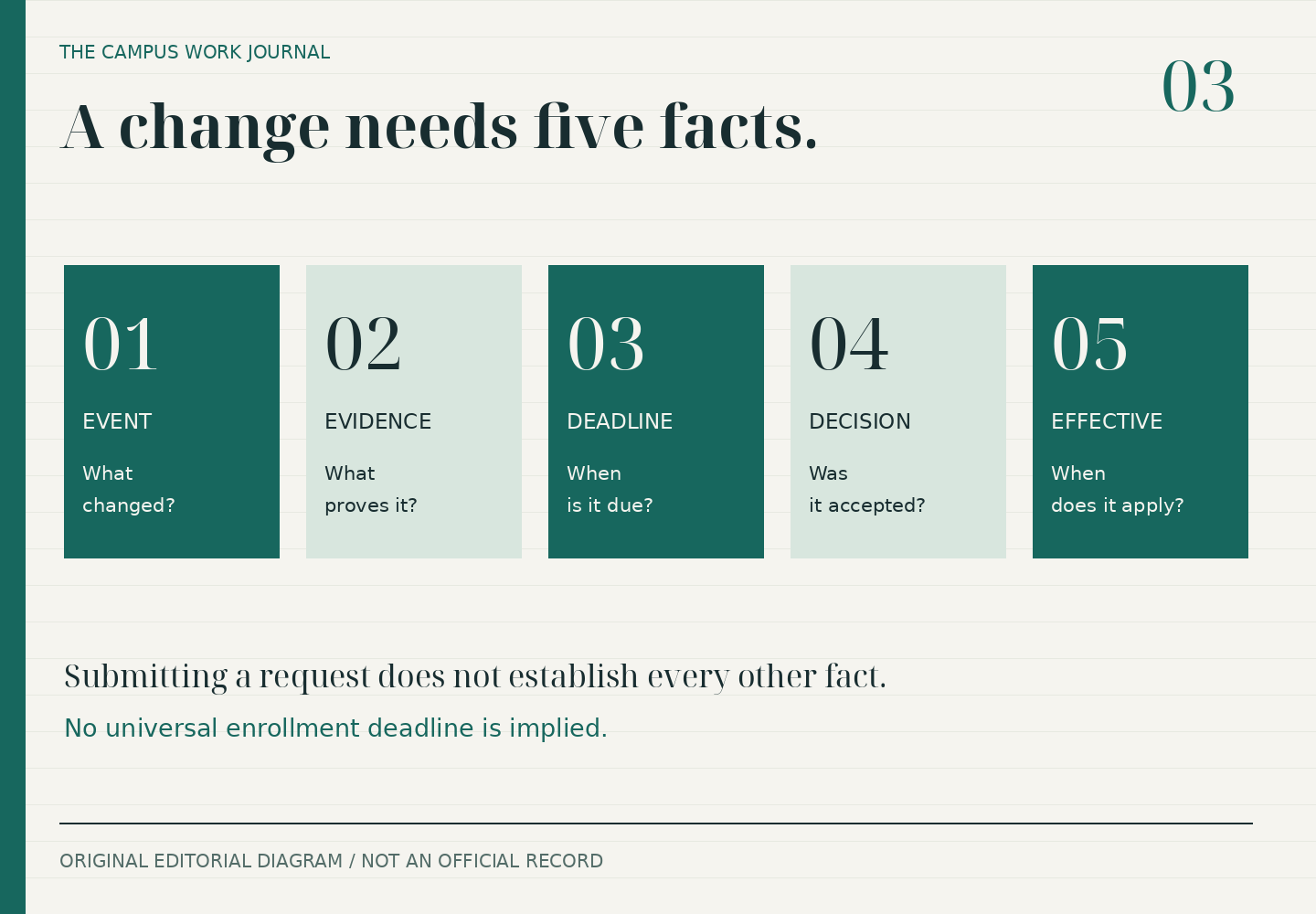
A life or employment change can create several benefits questions at once. Which plan applies? What event does the plan recognize? What evidence is required? When must a request be received? When would an accepted change become effective? Those questions are connected, but a single remembered deadline cannot answer all of them.
The University's Human Resources Benefits Forms directory includes separate benefit actions for events such as gaining or losing other coverage and adding or removing a spouse or partner. The directory is useful because it shows that “change my benefits” is not one undifferentiated transaction. It does not, by itself, establish an individual's eligibility or the deadline for a particular event.
Identify the plan and employee population first
Before using a colleague's experience as a guide, establish which benefits program covers your position. The University's Policy 5-303: University Insurance Programs policy states that different health and dental plans may be provided for Hospitals and Clinics employees and other University employees. A shared employer name therefore does not guarantee identical enrollment instructions.
Ask the appropriate benefits office to confirm the relevant plan and event category. You do not need to disclose a complete medical or family history in an initial inquiry. A concise description of the administrative question can establish the route, after which the office can explain what information belongs in its official process.
This publication does not determine coverage, recommend an insurance election, or evaluate a dependent's eligibility. It also does not collect supporting documents. Its role is to help you separate the facts needed to ask the official questions before a time-sensitive opportunity is lost.
Write an event statement without turning it into a conclusion
A useful event statement describes what changed and when, using the terms in the official evidence. It does not announce that the event qualifies unless the plan or benefits office has confirmed that. For example, the end of another coverage arrangement may raise an enrollment question, but the appropriate evidence and timing must be established through the actual plan.
In a fictional scenario, Morgan receives a notice concerning another employer's coverage. The notice has an issue date, a coverage-ending date, and a date when employment changed. Those dates may be different. Morgan should ask which date the University needs for the event rather than selecting whichever date produces the most convenient deadline.
Keep a copy of the official notice only in an appropriate private location. Do not send it to this magazine or paste its contents into the local planner. The planner's categories are generic rehearsal choices, not an application or a record of your actual event.
Ask for the deadline before assembling the perfect packet
Benefits changes can be time-sensitive. If the deadline is unknown, contact the appropriate office promptly and ask what must be submitted, through which channel, and by when. Do not delay the inquiry while collecting every conceivable document. An incomplete but timely question can identify what is actually needed.
This article intentionally does not repeat a universal number of days. Different events, plans, employee populations, and requests can have different rules. A number remembered from another university or another employer is particularly unsafe. Obtain the current deadline for your exact event and preserve the office's explanation of what counts as timely submission.
If a deadline is provided in calendar days, business days, or by a particular time, retain that wording. Ask about any ambiguity rather than converting it silently. Also ask whether the deadline concerns initiating a request, submitting all evidence, or completing another step. Those are materially different obligations.
Submission, acceptance, and effective date are separate milestones
A portal may confirm that a request was submitted. That confirmation is useful evidence, but it may not establish that the request is complete or accepted. An acceptance may establish a change while leaving a separate question about when payroll deductions will reflect it.
For a fictional example, Morgan submits a request, receives a message asking for additional evidence, and later receives a confirmation. The first submission date, evidence date, and confirmation date should remain distinct in the record. Renaming the first message “approved” would erase the unresolved stage and make later questions harder to answer.
Ask how an accepted change will be confirmed and which effective date applies. Then ask, separately, how that change should appear in the relevant payroll or plan record. Do not infer active coverage from a deduction alone or infer rejection from the absence of an immediate deduction change.
Build a document checklist from official instructions
The best checklist is short because every item has a reason. Record the requested document type, the fact it needs to establish, the approved submission route, and whether the office says an item is still missing. Do not collect extra identity or health information simply because it might be useful.
Sensitive documents can include information about family members who are not part of the immediate question. Follow the official instructions for what must remain visible and how to transmit it securely. If the instructions are unclear, ask before sending. Ordinary publication email is not a secure benefits-review channel.
A checklist can also distinguish a copy you keep from a document you submit. Keeping a personal record does not mean every recipient needs it. Avoid scattering the same attachment across multiple email threads when the University has specified a single official destination.
Consider related records without assuming automatic updates
A benefits event can coincide with an address change, a name change, a beneficiary review, or a change in employment status. These may be separate administrative tasks. Do not assume that completing one form updates every other record that happens to contain the same information.
The Human Resources Benefits Forms directory lists beneficiary updates separately from several enrollment changes. That is a useful reminder to ask which records are affected by the action you are taking. It is not a recommendation about whom to designate or which coverage to choose.
Make a private list of related questions, then verify each through the appropriate official service. Avoid using a single broad instruction such as “update everything,” which can conceal choices that require your specific decision. An employment record, a plan enrollment, and a beneficiary designation have different consequences.
When the answer is unclear or the window may have passed
Contact the benefits office rather than assuming that a missed or uncertain date ends the discussion. Describe the facts accurately and ask what options, if any, remain under the applicable process. This publication cannot promise an exception, appeal outcome, retroactive change, or continued coverage.
Preserve the response and any next action it identifies. If you are directed to a plan administrator or another office, verify the destination independently and share only the information requested for that purpose. A referral is useful, but it should not become an unrestricted transfer of every document you have collected.
The goal is an explicit result: the request is accepted with a stated effective date, additional action is needed, or the office has explained why the requested change cannot proceed. A generic “submitted” screen is not a substitute for knowing which of those situations applies.
Close the file only when the outcome is understood
A benefits-change record is complete when you understand the official decision, the effective date, and any remaining administrative steps. Payroll reflections may need their own later check. Keep those checks attached to the actual confirmation rather than to an assumption based on the next paycheck.
Good preparation does not make a complex event simple. It makes the uncertainty visible early enough to ask the right questions. The event, evidence, deadline, decision, and effective date are five different facts. Keeping them separate is the most useful service an employee's own checklist can provide.
Sources and reading limits
Public sources reviewed October 15, 2026. These links support the specific University context above; the comparison methods and hypothetical examples are original editorial work. No authenticated system was tested. Policies and interfaces can change. Individual pay, benefits, tax and employment decisions require the appropriate official or qualified advice.