In this article
Two campus jobs can share a university name and still require careful separation in the records. The work belongs to particular positions, departments, dates, and approval routes. Combining everything too early can make a payment look plausible while leaving time assigned to the wrong place.
The University of Utah's Introducing MyTime introduction highlights easier assignment of time to the proper position for employees with multiple jobs. That is a useful reminder of the reader's first task: identify which position a record describes before comparing the numbers. A total across jobs is a summary, not a substitute for those individual identities.
Build a position key in plain language
A private position key can be simple: the department, the role as you recognize it, the official position identifier if the University uses one in the relevant record, and the person or office that handles timekeeping questions. You do not need to copy every employment field into a separate spreadsheet.
The key helps distinguish two similar labels. A fictional employee, Avery, might work in a lab and a campus service role. If both entries are described only as “campus hours,” the distinction needed for approval and payroll review has already been lost. Naming the role in a private note makes a later question reproducible.
Keep the key factual. Do not infer an employment classification from a department nickname or an informal job title. If the official category matters to pay, leave, or benefits, ask HR to confirm it. A friendly label helps you navigate; it does not determine the governing rules.
Check assignment before checking the combined total
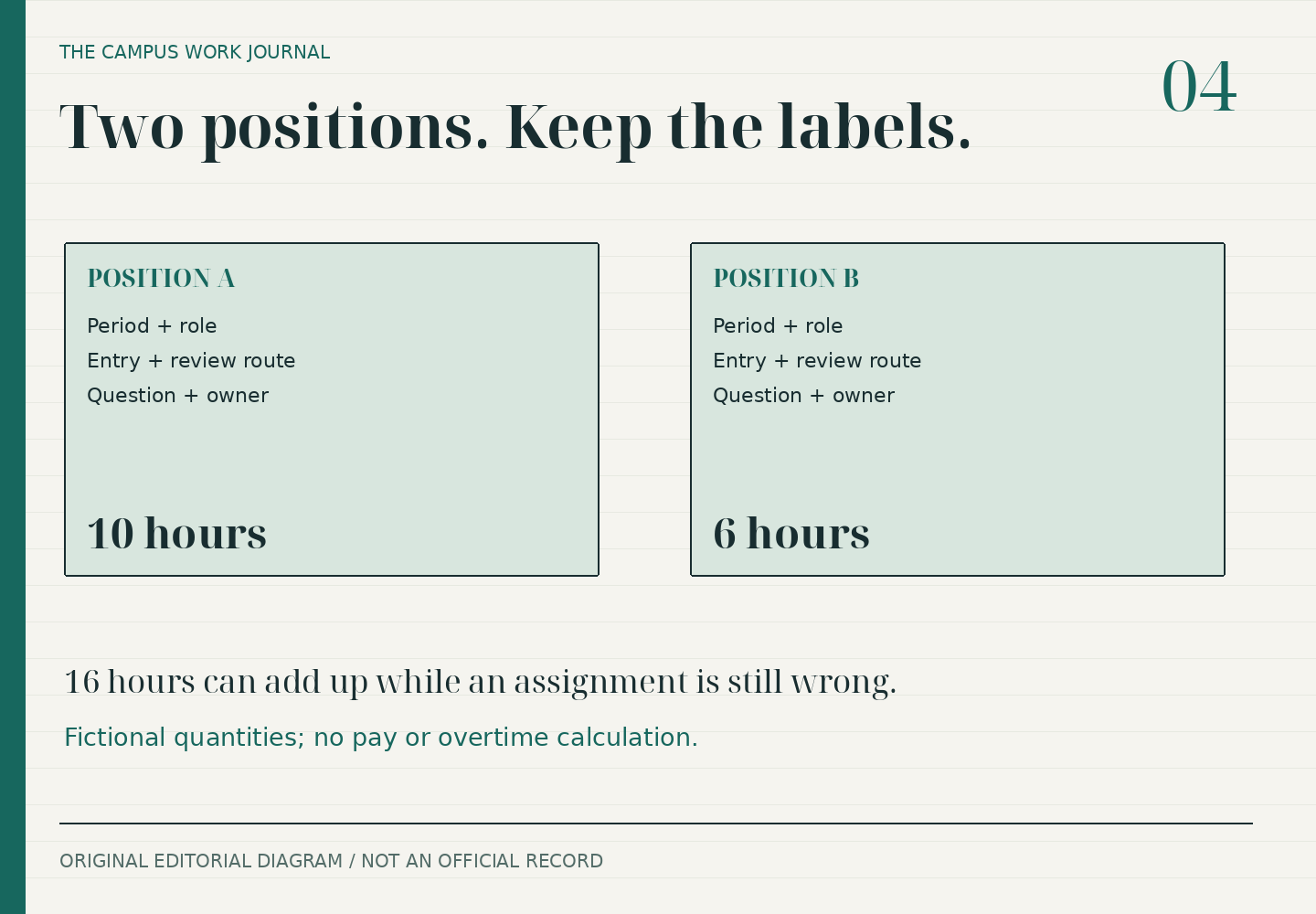
Suppose Avery records ten hours for one position and six for another. A total of sixteen hours may look right even if two hours are assigned to the wrong position. The combined total therefore passes one simple check while failing a more important assignment check.
Review each entry's position and date first. Then compare the position totals. Only after that should you make a combined descriptive total, if one is useful. This order preserves the information the relevant department needs to investigate a question.
The example is not an overtime calculation or a legal classification of multiple jobs. Those questions can require facts beyond a reader's summary. If the issue concerns how earnings across positions interact, ask payroll to explain the applicable calculation rather than treating the positions as separate employers or independently applying a rule to each.
Keep approval routes visible
Different departments may have different people responsible for reviewing a record. An entry under the wrong position can therefore create both an assignment problem and a handoff problem. The person who sees the entry may not be the person who can explain the work or authorize the correction.
Ask which official route applies when time is misassigned. Do not move or duplicate entries merely to make them visible to a preferred reviewer unless the University's process instructs that action. A duplicate can produce an additional reconciliation problem even if the original intention was only to get attention.
In a concise inquiry, identify the intended position, the position currently displayed, and the period. You do not need to include unrelated salary or benefits information. The first objective is to establish who can correct the assignment and which later record will demonstrate that it was corrected.
A paycheck can summarize more than one story
A single payment does not necessarily mean every line on the earnings statement came from the same position or event. A combined payment destination is particularly weak evidence of how the underlying work was assigned. Read the earnings detail and the time record according to their own labels.
The Earnings Codes reference can help translate a line's description, but a code alone may not identify the job. Preserve both the position context and the code. A regular-pay label tells you something about the category; it does not tell you whether the line belongs to the lab role or the service role in Avery's fictional example.
If a record does not clearly show the distinction you need, ask how to obtain the appropriate explanation through the official service. Do not assume that the absence of a position label on one display means the system lost the position information everywhere.
Keep effective dates attached to job changes
A second position may begin or end during a period. A rate or schedule may change while another position continues unchanged. A comparison that labels the entire period “before” or “after” can hide those boundaries.
Use the official effective date for the employment action when discussing the change. Keep it separate from the date an offer was accepted, the first day a manager mentioned the change, and the date the later statement was issued. If the dates differ, ask what each one means rather than forcing them to match.
For a fictional example, Avery starts a second role partway through a period. The first statement involving that role may contain only part of the period's activity. That does not establish the University's actual processing rule; it illustrates why a full-period expectation may be the wrong comparison. The actual record needs its own explanation.
Benefits and leave require population-specific answers
Holding two roles does not let an employee safely combine every rule associated with either role. Eligibility, leave treatment, and benefits can depend on official employment facts that a personal hours summary does not establish. The Policy 5-303: University Insurance Programs policy and related University rules provide context, but individual classification questions belong with HR.
Ask how the University treats the combination of positions for the particular question. Avoid a broad assumption such as “My total hours qualify me” or “My second position cannot affect anything.” Either could be wrong depending on the applicable arrangement.
The useful preparation is a factual list of the positions and effective dates, shared through the appropriate official channel when requested. Do not send appointment letters, medical information, or family details to this publication. The local planner cannot determine eligibility from a scenario choice.
Use one comparison sheet with separate sections
A practical private review can have a section for each position and a final combined line only when needed. Each section identifies the period, observed entries, expected entries, approval question, and the office handling any correction. That structure prevents one department's response from being mistaken for resolution of every job-related issue.
If the University explains a cross-position calculation, preserve that explanation as a separate relationship between the sections. Do not erase the individual records after producing a combined total. The combined number is easier to revisit when its components remain identifiable.
When the issue is resolved, confirm both assignment and result. The time may be attached to the intended position while a later payroll reflection is still pending, or a payroll adjustment may be explained while a timekeeping question remains. Two jobs produce overlapping records. Careful labels keep that overlap from becoming confusion.
Sources and reading limits
Public sources reviewed October 15, 2026. These links support the specific University context above; the comparison methods and hypothetical examples are original editorial work. No authenticated system was tested. Policies and interfaces can change. Individual pay, benefits, tax and employment decisions require the appropriate official or qualified advice.