In this article
A move to another University department can look like a simple change of workplace. In the records, it may involve an effective employment action, a new supervisor, different timekeeping responsibilities, leave treatment, pay conditions, and benefits questions. The useful preparation is to identify those separate handoffs before assuming that everything follows automatically.
The University's Policy 5-108: Transfer of Benefits Eligible Staff Members (non UUHC) policy was revised with an effective date of January 1, 2026. Its scope is specific: covered benefits-eligible staff moving into non-UUHC positions without a break in employment. That scope is the first question to settle with HR. An informal description such as “internal move” does not establish that every provision applies to your situation.
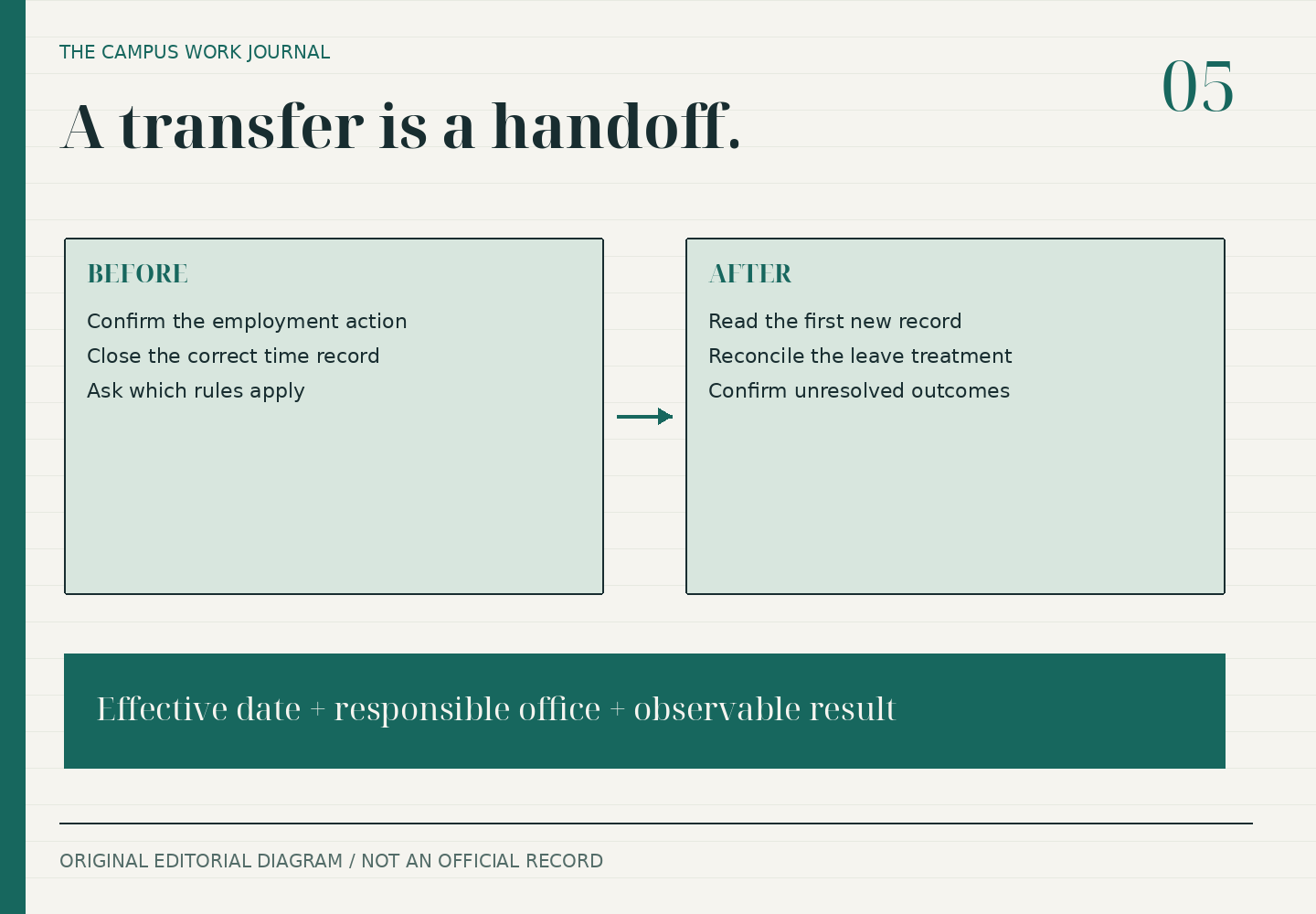
Confirm which kind of change is being processed
Ask whether the University is treating the event as a covered transfer, a new appointment, a change in status, a rehire, or another action. Those labels can have different consequences. Do not select a label simply because it sounds most favorable or matches a colleague's experience.
In a fictional example, Jordan finishes work in one unit on Friday and begins work in another on Monday. The calendar sequence alone does not prove how the employment record is being processed. The relevant facts include the official effective dates and the action the University records.
A concise written confirmation can prevent confusion later. It need not include every HR field. It should establish the action, effective date, receiving unit, and the person or office responsible for unresolved administrative questions. If the actual arrangement differs from an earlier discussion, ask for clarification before relying on the earlier description.
Read pay conditions from the actual offer and policy
A transfer does not automatically imply a pay increase. The current policy links permitted increases to defined grade circumstances and includes limits and an exception process. This article does not interpret those provisions for an individual employee or recommend a negotiation position.
The practical task is to compare the written offer or confirmation with the applicable official explanation. Identify the amount or rate, its unit, the effective date, and any conditions that require clarification. A monthly-looking figure and an annual figure are not directly comparable until their meaning is established.
Avoid estimating the first payment by dividing an annual salary into an assumed number of periods. A partial period, schedule, or other arrangement may require an explanation. Ask payroll which record should reflect the change and how the initial transition period will be represented.
Close the old time record without duplicating the new one
A transfer can place work for two units near the same payroll boundary. Keep the dates and position context clear. The old unit may need to review activity before the change, while the receiving unit handles later activity. The actual approval route should be confirmed through the departments' official process.
Do not enter the same work under both positions to ensure it is noticed. If an assignment is wrong, ask how to correct the existing record. Duplication can make a correct total harder to establish and can send conflicting information to different reviewers.
For a fictional period that crosses the transition, make a private note of which dates belong to which role. That note is an aid to asking a question, not an alternative payroll submission. Use the University's authorized timekeeping service and the instructions for the position involved.
Establish the leave treatment before relying on it
The transfer policy addresses unused leave for covered transfers, subject to applicable University regulations. That statement should be read with the policy's scope and the employee's actual category. It should not be generalized to every movement between campus and Hospitals and Clinics, every change in hours, or every return after a break.
Ask HR to confirm which balances carry, which rules govern them after the change, and which record will demonstrate the result. A statement such as “your leave is fine” may be reassuring but can leave several questions unanswered. A named category and effective date make the answer usable.
When the new record appears, compare the balance at the relevant dates rather than expecting two screens to show identical numbers forever. Usage, accruals, or adjustments may occur between observations. Preserve the movements needed to explain a difference instead of treating the difference as proof of lost leave.
Benefits questions deserve their own confirmation
A change in job or employee population can raise benefits questions even when the employee remains within the University. The Policy 5-303: University Insurance Programs policy recognizes different possible plans for Hospitals and Clinics employees and other employees. Do not assume that an internal move makes every election or coverage arrangement identical.
Ask whether the specific action changes eligibility, available plans, required elections, or the administrative office responsible. If a decision or deadline is involved, obtain the current instructions for the exact situation. This publication does not determine coverage or supply a universal transfer enrollment window.
Keep an accepted benefits change separate from the employment-action confirmation. The two may share an effective date, but that should be established rather than assumed. A later deduction can be checked against the benefits confirmation without using the paycheck as the only proof of coverage.
Check access as a work handoff, not an entitlement
A new role may need different systems or approvals. Access that remains from the old role may no longer be appropriate, while access needed for the new role may not yet be provisioned. Follow the University's authorized process instead of treating a working login as permission to use every old resource.
Before the transition, ask the departments which work files, approvals, equipment, and responsibilities must be handed over. Do not copy confidential research, student, patient, personnel, or business data into a personal location to make the transition easier. Personal employment records and University operational records need different handling.
A useful handoff note identifies the responsible person and the task remaining. It does not need to contain credentials or broad access instructions. If a necessary service is unavailable, report the specific work blocker through the verified support route.
Reconcile the first record after the move
The first relevant statement or time record after a transfer is a good moment to compare the official action with its visible result. Check the period, position context, earnings labels, and any confirmed leave or deduction changes. Do not assume every difference is caused by the transfer; identify the actual changed fields.
If something remains unclear, ask a narrow question that connects the confirmation to the record. “The action is effective on this date; which line reflects it?” is more useful than forwarding an entire employment history. The office can request additional evidence through the appropriate channel if needed.
A transfer is complete administratively when the relevant records and responsibilities have been reconciled, not simply when the employee reaches a new desk. The objective is a clean handoff: the old work is accounted for, the new role is correctly represented, and the questions that require HR or payroll judgment have explicit answers.
Sources and reading limits
Public sources reviewed October 15, 2026. These links support the specific University context above; the comparison methods and hypothetical examples are original editorial work. No authenticated system was tested. Policies and interfaces can change. Individual pay, benefits, tax and employment decisions require the appropriate official or qualified advice.