In this article
A campus job leaves more than one paper trail. Time is recorded in one place, a paycheck presents a calculated result, a benefits election expresses a choice, and an employment action establishes a change in the job itself. The records are connected, but they answer different questions. Treating every screen reached through Utah CIS as one interchangeable record is an easy way to investigate the wrong thing.
For University of Utah employees, the useful starting point is a map of the work. Which event are you trying to understand? Which record would demonstrate that the event happened? Who can explain the difference between what you expected and what that record shows? Those questions can turn an anxious search for a missing number into a short, actionable conversation with the right office.
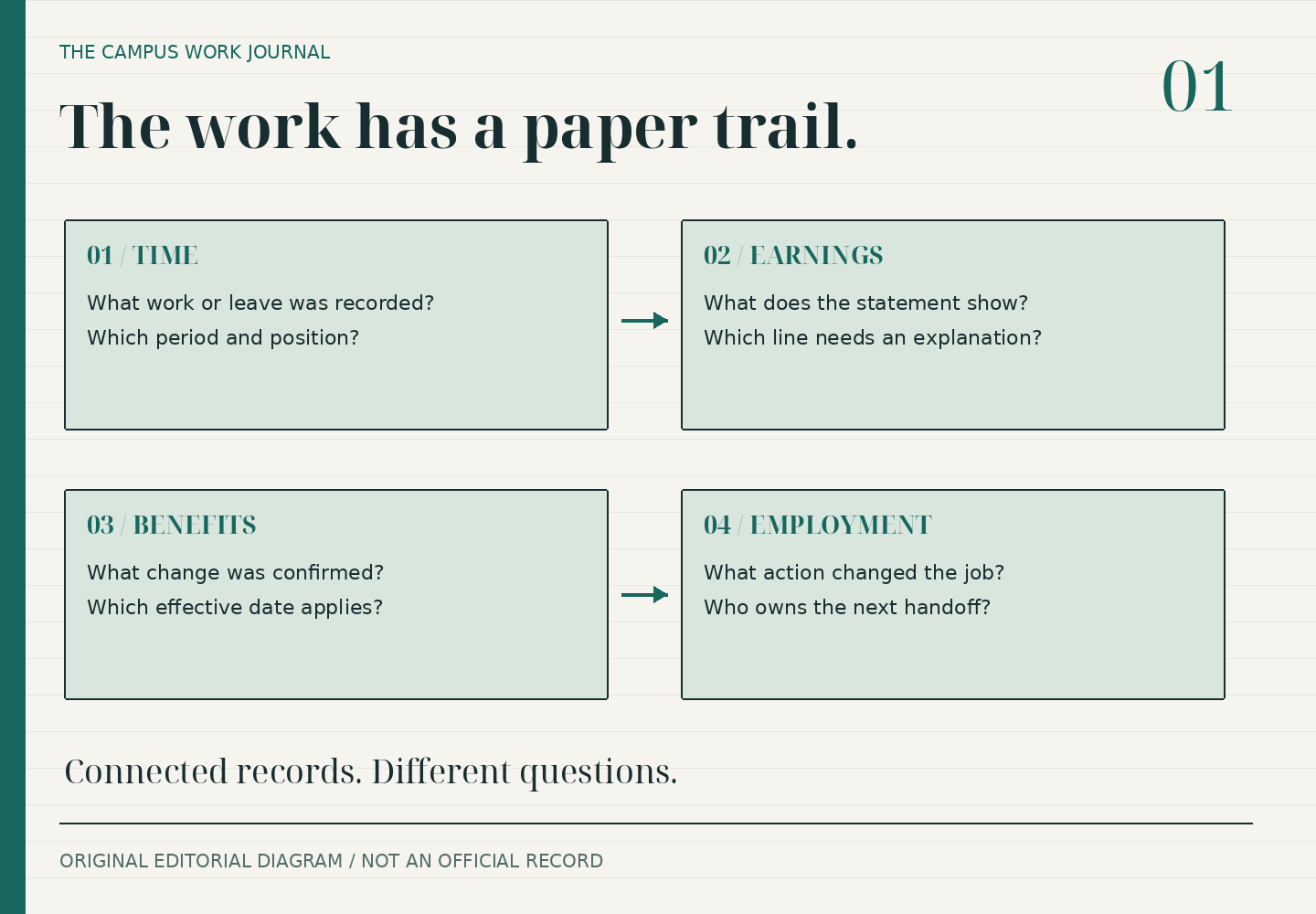
This is an independent editorial method, not an official payroll procedure. It asks for no credentials or private documents. You can use it with a blank sheet of paper and the University's own services. The purpose is to make the boundaries between records visible before making changes that may affect pay, benefits, or employment.
Four records, four different jobs
The University's Introducing MyTime announcement distinguishes MyTime timekeeping from paycheck viewing in CIS and identifies PeopleSoft HCM as the payroll calculation system. That distinction matters more than the appearance of a tile. An employee may correctly record time yet still need an explanation of a paycheck line. Conversely, an earnings statement may contain a result without showing every approval that preceded it.
Consider a fictional employee called Rowan. Rowan remembers working an additional shift, sees that shift in a time record, and expects a larger payment. There are at least four separate assertions inside that expectation: the shift belongs to the intended job, the entry has the relevant approval, it falls in the period being examined, and the earnings display represents it in the expected way. None of those assertions is proved merely by remembering the shift.
A fifth assertion concerns payment distribution. Even when a paycheck contains an expected net amount, the destination and availability of a payment are separate matters. Looking only at a bank balance cannot identify whether a difference began with time entry, an earnings calculation, deductions, or a distribution instruction. It gives one useful observation, but it is the last observation in a longer chain.
Identify the question before collecting evidence
Start with a sentence narrow enough that someone could answer it. “My pay is wrong” expresses a real concern but leaves the investigator to choose a starting point. “The time entry for my second position appears under my first position” identifies a possible assignment problem. “The deduction code changed between two statements” identifies a comparison. “I submitted a benefits change but do not know its effective date” identifies a decision that needs official confirmation.
Write down what you observed separately from what you expected. An observation is something a record actually displays: a date, a status, a line label, a category, or an amount. An expectation is what you thought should happen. Both matter. Keeping them separate prevents a reasonable concern from turning into an unsupported allegation or an accidental instruction to change something else.
Then add the smallest missing fact. Rowan might write, “I need to know which payroll period includes the approved shift.” That is a much stronger next question than trying to reconstruct an entire payroll calculation from partial information. If the answer reveals a second issue, the investigation can expand with evidence rather than guesswork.
Dates are coordinates, not interchangeable labels
A work date, pay-period ending date, payment date, benefits effective date, submission timestamp, and correction date can all appear in the same employment story. They do not become equivalent because they are close together. A note that says “October change” is therefore weak evidence. A note that identifies the particular record and the date label preserves the distinction another person needs.
For a fictional example, imagine a change requested on the tenth, an employment action effective on the fifteenth, and a statement issued later. The example does not predict a University processing schedule. It simply demonstrates why the request date cannot prove when an action took effect. The effective date cannot, by itself, prove which statement first reflects the result either.
The Payroll Schedule and Deadlines page separates payroll process deadlines, hourly calendars, and employment-action deadlines. Use the current official resource for the relevant question. Do not turn a deadline intended for departmental processing into a personal promise of payment. If a calendar label is unclear, ask what action the deadline governs and which office owns that action.
The employee population comes first
“University employee” is a useful description but not a complete benefits or leave category. Faculty, staff, trainees, and different organizational populations may have different arrangements. The University's Policy 5-303: University Insurance Programs policy explicitly allows different health and dental plans for Hospitals and Clinics employees and other University employees. A colleague's experience is therefore a prompt to investigate, not proof of your own arrangement.
Before relying on a guide, identify its stated audience and version. A public page about campus payroll can point to a separate hospital resource. A policy can apply to benefits-eligible staff while excluding another situation you assumed it covered. This is not an invitation to classify yourself using an informal checklist. Ask the appropriate HR contact to confirm the population and policy that apply to your position.
That simple habit also protects you from attractive but unrelated search results. A State of Utah employee page, another university's benefits FAQ, and an old departmental handout may all contain plausible language. Plausibility is weaker than an official source that names the right employer, population, and subject.
Build a compact comparison, not a document dump
A useful private working note has four columns in spirit, even if it is just four lines: record, observation, expectation, question. For Rowan, the record might be a timecard for a named period. The observation might be an entry under a particular position. The expectation might be assignment to another position. The question might ask which official correction route applies.
There is usually no reason to collect every record before making the first inquiry. Overcollection creates privacy risk and makes the central issue harder to see. Begin with identifiers and a factual description. If the University needs a document, use its verified instructions and an appropriate channel. Do not send pay statements, account numbers, tax forms, dependent information, or medical details to this publication.
A screenshot can be useful in an authorized support process, but it is not automatically the best evidence. It may omit a date, conceal a column heading, or include unrelated private information. A carefully described field can be more useful than an image of the whole screen. Ask what the recipient needs before creating extra copies.
Keep corrections connected to the original
A corrected record should not make the earlier question disappear from your understanding. Keep a short relationship between the original observation, the response, and the later result. “Payroll explained the line on this date” and “the later statement reflects that explanation” are different milestones. A reply alone may not establish that a change is complete.
For a fictional deduction issue, suppose a specialist explains that one amount reverses an earlier amount. Your next comparison should preserve both the sign and the section in which each line appears. A negative earnings line and a negative deduction can have different arithmetic effects. Avoid renaming both as “refund” before the office has explained what they represent.
Likewise, a request marked submitted may be awaiting review. A confirmed effective date may be awaiting reflection in another record. A changed display may still need an explanation. Good recordkeeping avoids forcing all three into a single “done” box.
Use the Record Handoff Planner as rehearsal
The local planner on this publication's homepage offers six generic situations and a choice of which evidence is available. It builds a short preparation list and a question to ask the appropriate office. It does not connect to CIS, determine eligibility, calculate pay, set a deadline, or submit a request. It accepts no names, dates, salaries, account details, or documents.
Its value is in the order of attention. A time-entry question starts with the period and position; a benefits-event question starts with the correct plan and the official deadline; a departure question starts with the separate employment and records-access arrangements. These are starting points, not barriers you must complete before seeking help.
If the issue is urgent, contact the relevant University office promptly. Do not delay a time-sensitive benefits or payroll inquiry while trying to perfect a checklist. A concise incomplete question is often better than a polished packet sent too late. Make uncertainty explicit and ask what must happen next.
What a useful answer should establish
At the end of a productive exchange, you should know which record the answer concerns, which action is required, who owns it, and how to recognize the result. If an office provides a deadline, preserve its exact meaning and time zone where relevant. If a correction is expected, ask which later record should show it rather than assuming the next screen refresh will settle the matter.
The goal is not to become your own payroll processor or benefits administrator. It is to be a careful reader of your employment records. Utah CIS can be a doorway into that work. The record map helps you decide what to look for once you reach the appropriate official service, and what to ask when the pieces do not yet line up.
Sources and reading limits
Public sources reviewed October 15, 2026. These links support the specific University context above; the comparison methods and hypothetical examples are original editorial work. No authenticated system was tested. Policies and interfaces can change. Individual pay, benefits, tax and employment decisions require the appropriate official or qualified advice.