In this article
Year-end payroll review works best when it begins with document identity rather than a rush to make two totals match. A final earnings statement and a Form W-2 describe related activity, but their fields are designed for different purposes. A difference is a question to investigate, not proof that one document is wrong.
The IRS General Instructions for Forms W-2 and W-3 (2026) explain the distinct wage and withholding boxes on Forms W-2 and W-3. This article uses that distinction to organize a reading method. It does not prepare a return, calculate a tax liability, recommend withholding, or determine which tax treatment applies to an individual employee.
Start with the year, employer, and version
Check the year printed on the form and the employer it identifies before comparing any amounts. A file downloaded this year may concern a prior tax year. A corrected form may need to be read alongside the original according to official instructions. The download date is not the tax year.
In a fictional example, an employee has two files named “tax form” and “tax form new.” Those names conceal the information needed to compare them. A private naming convention that includes the document type, year, and whether the form is a correction is more useful than a sequence of vague “final” labels.
Keep the original document intact. Do not edit an official tax form to make a preferred total appear, and do not write over it with an informal calculation. Any personal reconciliation should be a separate note, clearly labeled as your question rather than as a replacement official record.
Match definitions before matching numbers
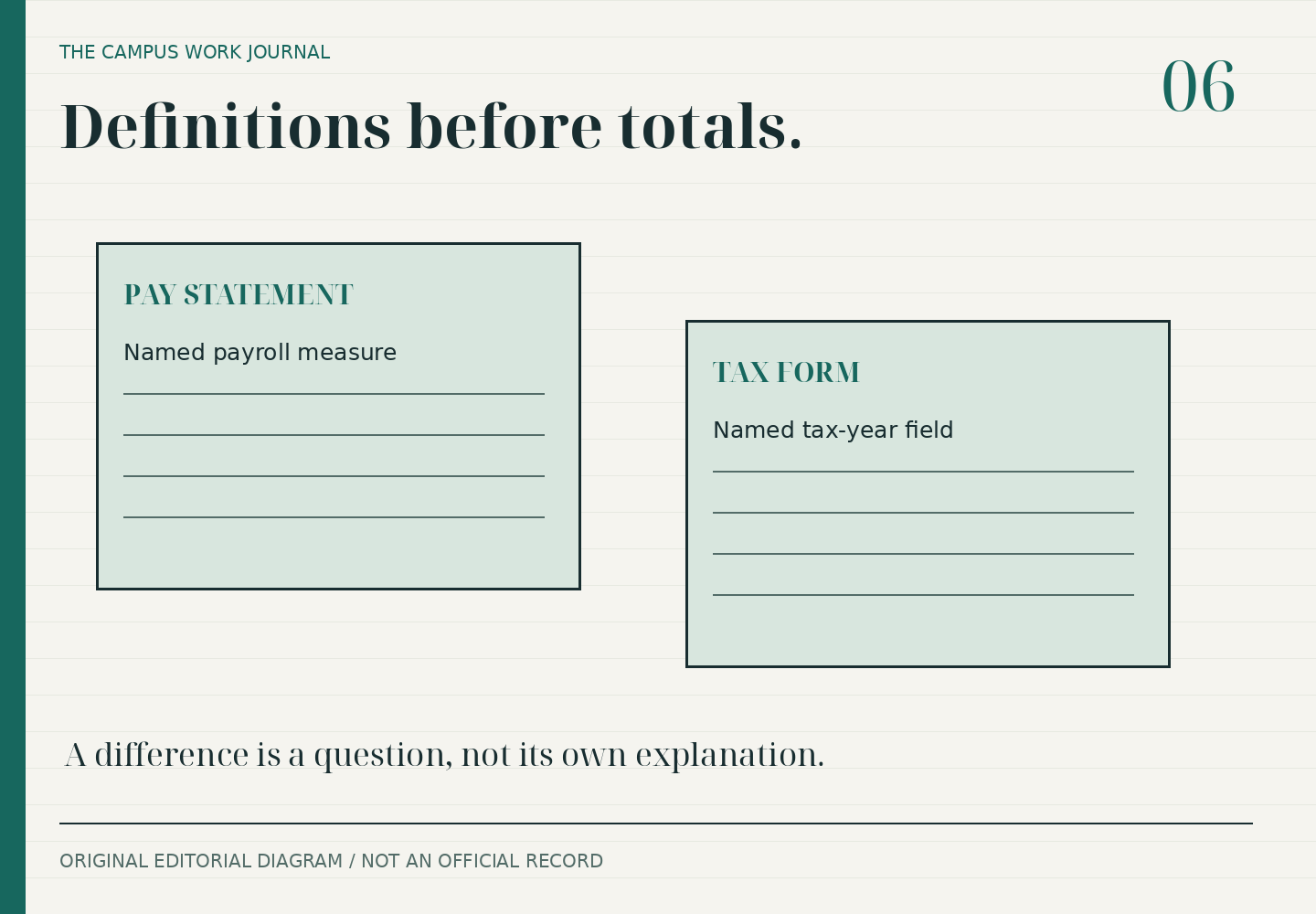
A payroll gross-earnings total is not automatically the same measure as every wage box on a tax form. The IRS instructions provide box-specific definitions. Read the named field, then ask the University to explain any bridge between that field and the payroll measure you are comparing.
For a fictional illustration, a payroll total of forty thousand dollars and a separately defined wage measure of thirty-eight thousand five hundred dollars differ by fifteen hundred dollars. The difference does not identify its own cause. It would be wrong to label it a particular deduction merely because that explanation seems familiar.
A useful reconciliation needs supported components. If the University explains an adjustment, preserve its description and the fields it connects. Do not assume the same adjustment applies to another wage box or another employee. The example demonstrates comparison structure, not a tax rule.
Keep withholding separate from annual liability
An amount withheld during payroll is a recorded payment toward a tax process. It is not, by itself, the answer to what an employee ultimately owes or receives back. A year-end statement can help establish what was withheld without predicting the outcome of a return.
Avoid dividing withholding by gross earnings and calling the result your personal tax rate. The ratio may be mathematically correct but conceptually incomplete. Other income, deductions, credits, filing circumstances, and applicable rules can matter to an annual tax result.
If you need individualized tax guidance, use a qualified adviser or the appropriate official resources. This publication's role is narrower: identify the documents, preserve the definitions, and help frame a factual payroll-record question. It does not ask for the private information required to prepare a return.
Do not project an old reprint form into the current year
At our October 15, 2026 review, the University's public University Tax Services W-2 Reprint Request PDF PDF still described forms through tax year 2024 and included dates tied to 2025. That is useful evidence of a version boundary. It is not a reliable basis for declaring the fee, availability date, or process for a later year's form.
If you need a current or older replacement, confirm the applicable instructions with University Tax Services through verified official resources. Do not pay a fee or send identity documents merely because an old search result contains a plausible procedure. Establish that the instructions apply to the year and employee status involved.
This is also why a search result's recent crawl date should not be treated as a document's effective date. A crawler can revisit an old form today. The content inside the form still needs to be read for its actual year and scope.
Name and address questions need precise routing
The University's Chosen Name: Employment Services guidance explains that payroll and tax documents continue to use the legal name in situations where other systems may display a chosen name. A difference between a directory display and a tax document is therefore not automatically a data error.
If the legal record itself needs correction, use the University's current approved process and provide required evidence only through its verified channel. Do not send identity documents, Social Security information, or copies of tax forms to this publication. Our contact page cannot process a legal-name change.
Address questions should also be specific. Ask which address record governs the particular document and whether a change affects an already issued form or only later correspondence. Updating a general profile does not prove that every historical document will be regenerated.
A correction is a linked record, not a silent replacement
When an official corrected tax document is issued, preserve its relationship to the original. The correction may concern particular fields rather than every amount on the form. Follow the official instructions and obtain qualified advice where needed for any filing implications.
Your private comparison can identify the original field, the corrected field, and the date the correction was received. Avoid treating the difference as new wages received at the moment you downloaded the correction. The document's purpose and year control the comparison, not the moment it appeared in your folder.
If you requested a correction but only received an explanatory reply, ask whether a corrected document will be issued and how to recognize it. A helpful response can resolve a misunderstanding without changing a form. Those are different outcomes, and your notes should reflect which one actually occurred.
Build a small secure year-end folder
A useful folder contains the relevant official documents, any permitted payroll statements needed for a question, and a short reconciliation note. It does not need to contain every email, screenshot, or account record from the year. More copies create more places where sensitive information can be exposed.
Use a secure location appropriate to tax records and the rules governing any work device or service. Do not place the folder in a publicly shared drive or upload it to an editorial tool. The Record Handoff Planner on this site takes only generic choices and cannot review a tax file.
For a question to University payroll or Tax Services, begin with the year, document type, field, and nature of the discrepancy. Let the verified office specify any additional information and submission method. A clear first inquiry often requires fewer sensitive details than a complete document dump.
Know what has been resolved
A year-end review is complete when the relevant fields are understood, an identified error has an official correction path, or the remaining question has been directed to appropriate professional advice. It is not complete merely because a spreadsheet produces the same number twice.
The strongest file preserves definitions and outcomes. It shows which year and employer each document concerns, which version is current, which difference was explained, and which question remains. That is a useful foundation for later work without pretending that a paycheck and a tax form must tell their stories in identical columns.
Sources and reading limits
Public sources reviewed October 15, 2026. These links support the specific University context above; the comparison methods and hypothetical examples are original editorial work. No authenticated system was tested. Policies and interfaces can change. Individual pay, benefits, tax and employment decisions require the appropriate official or qualified advice.